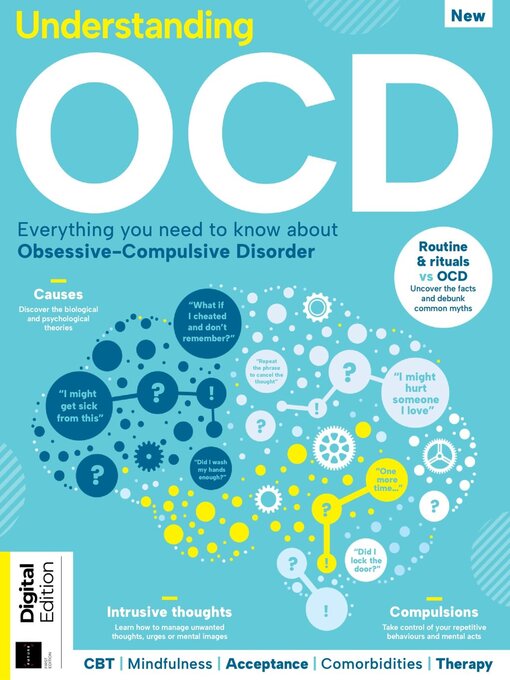
Understanding OCD delves deep into what is meant by obsessional thoughts and compulsive behaviours, and debunks many of the myths associated with the disorder. It explores common types and symptoms, lesser-known varieties, potential biological and psychological causes, and how it presents differently depending on age, gender and culture. Get to know the mental health conditions that often co-exist with OCD, such as anxiety, stress, tic disorders, ADHD and autism, and weigh up the benefits of seeking support and getting a diagnosis. We look at self-help strategies, as well as effective therapies, such as CBT, ERP and ACT, and also consider the roles of medication and mindfulness practices. Whether you have the condition yourself or you’ve picked up this book to support a loved one, you’ve come to the right place.
Welcome
Understanding OCD • A combination of intrusive, obsessive thoughts and repetitive, compulsive actions makes this mental health condition debilitating for those who suffer. We explore what OCD is and how to manage it
Related conditions
Intrusive and obsessive thoughts • We explore what intrusive thoughts are and when they become obsessive thoughts
Accepting obsessive and intrusive thoughts
Distract yourself from unwelcome thoughts
5 ways to manage obsessive thoughts • Here are some quick tips to manage intrusive and obsessive thoughts – we’ll deep-dive into these in more detail throughout this book
Compulsions • In response to an obsession, a person with OCD feels compelled to perform mental rituals and repetitive acts
Compulsions versus habits
When reassurance becomes compulsive
Common types of OCD • People who experience OCD usually find that their symptoms fit into one of five common themes
Obsessive-compulsive personality disorder
What is hoarding disorder?
Pure-O OCD • What is pure-O OCD and how is it associated with obsessive-compulsive disorder?
Lesser-known OCD types • Obsessive-compulsive disorder takes many forms. Here are some types you might not be aware of
Effective treatment options
Myths and misconceptions • We break down ten common myths related to OCD and explore the realities of each
Causes and risk factors • Getting a clear picture of what causes OCD can feel like solving a giant puzzle – with many different segments involved
Biological theories
Implications for pharmacological treatments
Implications for psychological treatment
Psychological theories • Cognitive distortions, temperament and co-existing mental health problems
The diathesis-stress model
Implications for neuromodulation treatments
OCD in context: Age, gender and culture • OCD isn’t a one-size-fits-all condition. Its presentation is as varied as the people who have been diagnosed
OCD in children
Comorbidities • When OCD exists alongside another condition, it can be difficult to tell where one starts and the other one ends
Treating OCD alongside other conditions
OCD and anxiety • We explore what anxiety is, the signs and symptoms, and its impact on your OCD
What causes panic attacks?
Anxiety disorders that can co-exist with OCD
Impact of anxiety on OCD
How stress affects OCD • Stress can greatly impact OCD symptoms – here’s how your body responds
The stress response • The body has a well-tuned system for dealing with the first signs of stress
The stress cycle
Blocking stress molecules
The effects of stress • Too much stress can have a negative effect on different parts of the body
Tic disorders and OCD • Tic disorders are a group of conditions that commonly occur alongside OCD
Alternative treatments...